
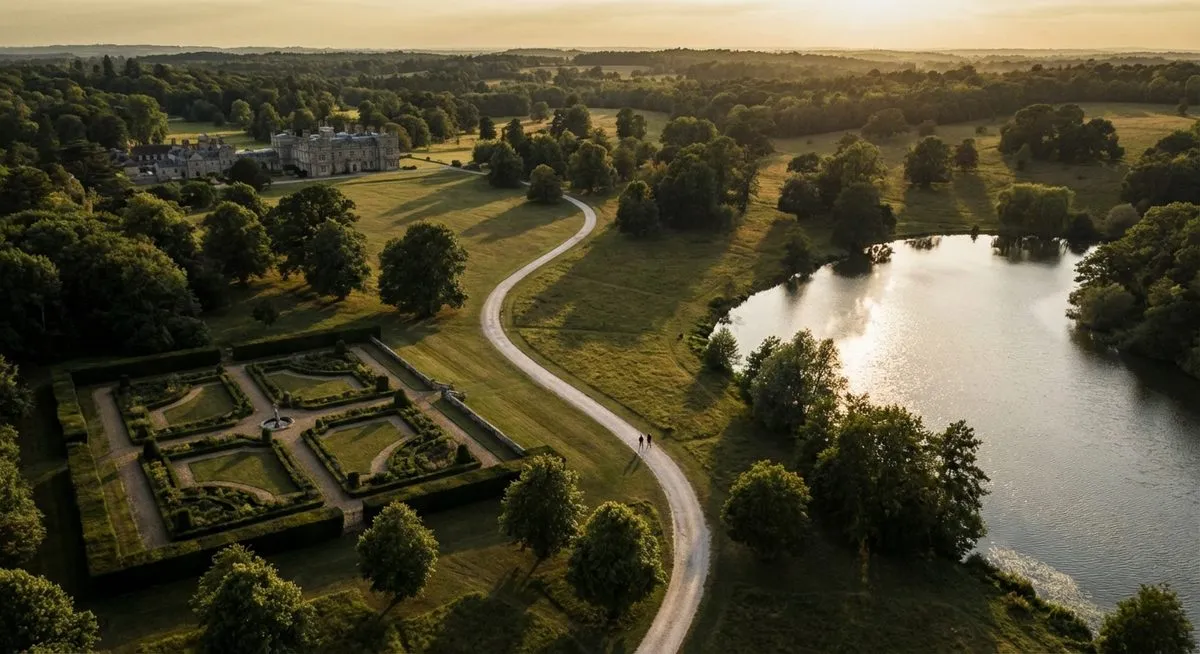
Country hotels invest more in their grounds than in almost anything else. The landscaping, the planting, the trails through the woodland, the garden that took three years to establish. And then most guests walk to the restaurant and back. The investment is real. The return depends entirely on whether guests actually experience it.
This is not about technology or digital maps. It is about what happens to reviews, to return visits, and to the way guests feel about your place when they discover the grounds you have spent years building.
The Retention Problem
The average guest retention rate in the hotel industry is 55%, according to a 2025 cross-industry study cited by ADA Cosmetics. That means nearly half of all guests never come back. For a country hotel that relies on return visits and word of mouth, that gap is where revenue goes to disappear.
The question is what makes someone rebook. And the answer, consistently, is not the room. It is the experience they had outside it.
What Discovery Does to a Stay
There is a measurable difference between a guest who glances at the grounds from the dining room and one who spends an hour exploring them, who finds the ice house hidden in the hillside, learns that the lime avenue was planted to celebrate a wedding in 1740, and sits on a bench overlooking the valley wondering why they have never been here before.
Longer stays outside, richer stays overall
Guests who have a reason to explore spend dramatically more time on the grounds. Instead of twenty minutes before lunch, they take a proper walk. An hour, sometimes two. They find places they were not expecting. They sit somewhere beautiful and do nothing for a while.
Give a guest a reason to keep walking and they see far more of the grounds than they otherwise would. That is not a marginal improvement. It is the difference between a guest who glanced at your grounds and one who fell in love with them.
Better reviews
Guests who discover something unexpected during their stay tend to leave happier, and they write the kind of reviews that drive bookings. The secret garden. The folly in the woods. The view from the ridge that regulars already know about.
These are the details that separate a good review from a glowing one. Guests rarely mention the room. They write about the moment they turned a corner and found something they were not expecting. And better reviews translate directly into pricing power. Research from Cornell's Center for Hospitality Research has found that a one-point rise in a hotel's review score lets it raise prices by around 11% without losing occupancy.
Return visits
A property that reveals itself slowly is a property worth returning to. If the grounds tell different stories in spring and autumn, guests have a genuine reason to come back: there is more of the place still to see.
According to Bain & Company, a 5% increase in customer retention can boost profits by 25–95%. Keeping a guest is worth far more than winning a new one, and the grounds are what bring them back. VisitEngland's Annual Attractions Survey found that farm attractions and heritage visitor centres saw some of the strongest growth in visits across England (11% and 6% respectively), a sign that guests are increasingly drawn to places where the grounds and landscape are the experience.
Nobody books a return trip because the towels were nice. They book because they want to see the bluebells in April, or the autumn colour they missed last time, or the woodland walk their friends told them about.
The Grounds You're Already Paying For
This is the part that does not get discussed enough. Every acre of your grounds costs money to maintain. The gardeners, the trails, the planting, the fencing, the tree surgery.
When guests stick to the terrace and the nearest path, you are maintaining the rest of the grounds for nobody. The walled garden that took a decade to restore gets walked past. The woodland trail you cleared last winter gets used by dog walkers, not guests. The view from the top of the hill, the one that makes everyone stop and stare, never gets reached.
You have already paid for the landscape. Helping guests see all of it is how that investment starts paying you back.
What Changes Look Like
You do not need a spreadsheet to picture the shift. It looks like this:
| Before | After | |
|---|---|---|
| Where guests go | The terrace and the nearest path | The walled garden, the woodland, the view from the ridge |
| Time outdoors | A quick look before lunch | A proper walk, an hour or more |
| What the review says | "Nice gardens" | "We discovered the most amazing walled garden with a story about..." |
| Why they rebook | "It was lovely" | "We want to see it in a different season" |
How Properties Are Doing This
The properties that excel at this do not hand guests a brochure and hope for the best. They make exploration feel natural and effortless.
A story map is one approach: a GPS-powered map that guests open on their phone by scanning a QR code at reception. No app to download, nothing to install. As they walk the grounds, stories appear based on where they are. The history of a building, the ecology of a woodland, the tale behind a garden gate. Each story is brief, beautiful, and self-contained.
But the principle is bigger than any single tool. It is about recognising that your grounds are not a backdrop to the stay. They are the stay. And they need the same care and attention to storytelling that you give to your restaurant menu, your rooms, and your welcome.
The Practical Cost Question
Most properties already spend real money reprinting maps every season: design, printing, storage, and the stack that gets recycled each time something changes. A digital map often pays for itself in those costs alone.
But the real return is not in what you stop spending. It is in what starts happening. The reviews get better, because guests finally have something worth writing about. They stay on the grounds longer, which is time not spent driving to other attractions. Return bookings climb, because seasonal stories give people a reason to come back. Word of mouth grows, because discovery is the most shareable thing there is, and "we found this incredible hidden garden" is exactly what people tell their friends. And your front desk fields fewer "what should we do today?" questions, because the map already answered.
The Question Worth Asking
You have invested in a landscape that has stories to tell. The question is simple: are your guests hearing them?
Not the guests who already know the estate well. Not the ones who grew up walking these paths. The first-time visitor. The couple who booked because of a friend's recommendation. The family who arrived Friday afternoon and left Sunday without ever finding the folly, the lake, or the view from the ridge.
Those are the guests who would have loved your place even more than they did. And they would have told everyone about it.