
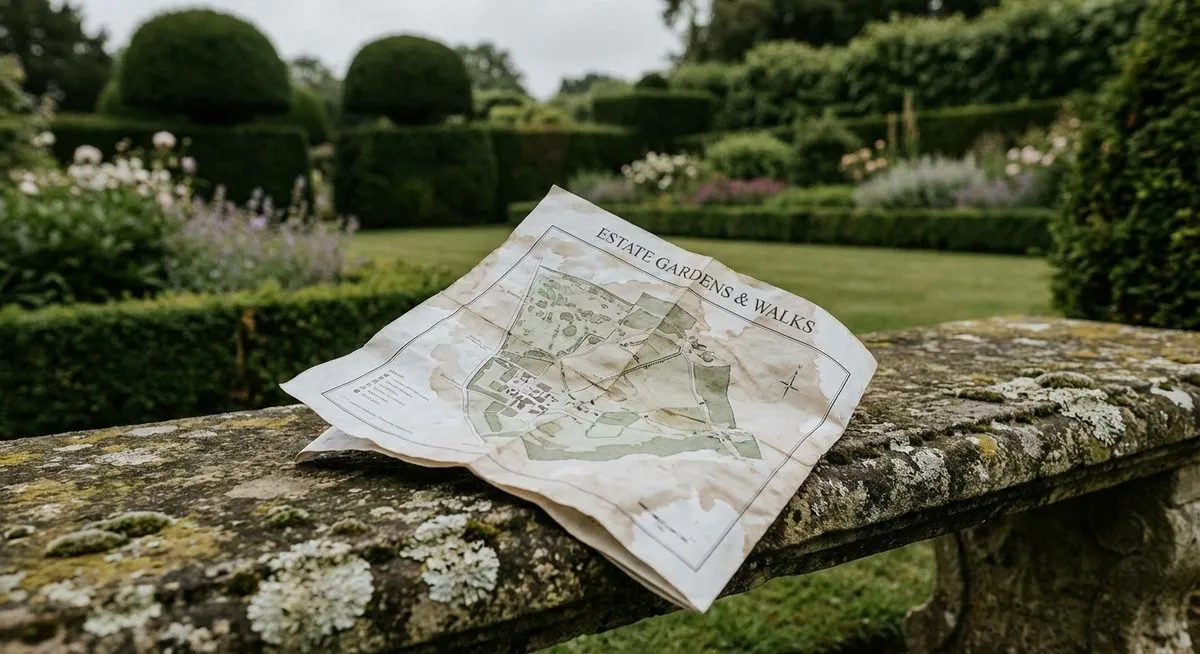
Most estates have a map of some kind. A laminated sheet at reception. A printed leaflet in the room. A framed map on the wall by the boot room. The question is not whether you have a map, but whether it is actually working. Here are five signs that it might not be.
1. Guests Ask "What Should We Do?" at Reception
If your front-of-house team regularly fields this question, it means the map is not doing its job. A good map shows where things are and gives guests a reason to go there. It answers the question before it is asked.
When a guest has to ask a person for guidance, the map has failed as a wayfinding tool. And every conversation at reception about "where to walk" is time your team could be spending on something else. A cluster of signs and arrows tends to overload guests rather than invite them: it tells them where things are without giving them a reason to go.
The fix is not more information on the map. It is better information. Not "Kitchen Garden: 200m" but "Through the oak door, a century of history, and the figs are almost ripe."
2. Reviews Mention the Room But Not the Grounds
Read your last twenty reviews. How many mention the grounds, the gardens, or the landscape? If the answer is fewer than half, your guests are not experiencing the full estate, which means they are not writing about it.
Reviews that mention discovery and exploration are the ones that sell. "Lovely room, good food" could be any hotel in the country. "We found a hidden walled garden with the most incredible story" describes yours.
If your reviews read like they could belong to any property in the county, your grounds are not making enough of an impression. The guests who get beyond the room and into the grounds are the ones who write the reviews worth reading. If the grounds are not making an impression, the map is not doing its work.
3. You Find Maps in Bins, Pockets, and Car Footwells
Paper maps have a short life. They are picked up at reception with good intentions, glanced at once, folded badly, and abandoned. They get wet. They tear. They are last year's version with this year's path closure unmarked.
If your housekeeping team regularly collects discarded maps from rooms and grounds, the format is the problem. A guest who would never use a printed map will happily scan a QR code, because it requires no effort, no commitment, and no pocket space.
The best map is the one that is always with the guest, always current, and never ends up in a bin. That is a phone, not a piece of paper.
4. Guests Only Visit the Nearest Garden
Watch where your guests go. If they walk from the main building to the nearest garden, take a photograph, and walk back, your map is not pulling them further. The folly in the woods, the lake at the edge of the parkland, the view from the ridge, all missed, because nothing invited guests to keep going.
A map that only shows locations is like a restaurant menu that only lists ingredients. It tells you what exists without giving you a reason to want it. Stories are the reason. What a guest remembers, and what brings them back, is rarely the list of amenities; it is the thing that made them feel something. A guest who knows that the folly was built in 1780 by a lovesick second son will walk the extra fifteen minutes to find it.
5. Your Map Has Not Changed in Over a Year
Grounds change. Paths close and open. Seasons turn. New plantings mature. Old trees fall. If your map is the same one you printed eighteen months ago, it is almost certainly inaccurate, and guests notice when a map does not match reality.
More importantly, a map that never changes gives returning guests nothing new. Grounds shift with the seasons, as any estate manager knows from the booking diary, and a map that never changes is telling guests nothing has when everything has. The couple who visited last summer and return this autumn deserve a different experience: a different walk, a different set of stories, a different reason to explore. A static map says "nothing has changed." A seasonal map says "there is always more to discover."
What All Five Signs Have in Common
Each of these signs points to the same underlying issue: the map is providing information, but it is not providing an experience. A dot on a map tells a guest where they are. It does not tell them why they should care. What guests need is a reason to walk, a story to find when they arrive, and the confidence that they will not get lost along the way.
A story map addresses all five signs at once. It answers "What should we do?" before the guest reaches reception. It creates the moments of discovery that guests write about in reviews. It lives on the guest's phone, never in a bin. It draws guests beyond the nearest garden with stories that reward exploration. And it changes with the seasons, giving returning guests something new every time.
If you recognise two or more of these signs, your grounds have stories worth telling. They just need a better way to tell them.